
Email notifications
Send incident notifications to an email address or distribution list.
Send Xyte incident notifications to one or more email addresses or to a distribution list.
How to set up
- Go to Connections → Integrations and open the Email tab (under Email notifications).
- Work through the steps:
- New Incident Email Template (optional) — the subject and body of the email sent when an incident opens. See the Customize the emails tab.
- Closed Incident Email Template (optional) — the same, for when an incident is resolved.
- Filtering (optional) — report only incidents at or above a chosen priority. See the Filter by priority tab.
- Enable — turn the integration on.
- Set the address that receives the notifications under Settings → Notifications. Each space can override it, so different customers, sites or rooms can notify different people.
Every step saves itselfEach step has its own button — Update on the two template steps, Save filtering on Filtering, Enable on the last step. Prev / Next only move between steps and save nothing.
Distribution listsTo notify a group, create a mailing list with your email provider and use that list address as the recipient.
Once enabled, incident notifications are sent to the addresses configured for each space. To control which incidents a space sends, and to whom, use that space's Routing settings.
Customize the emails (optional)
Two steps hold two independent email templates:
- New Incident Email Template — sent when an incident opens.
- Closed Incident Email Template — sent when it is resolved.
Each has a Subject and an Email Body. Type any text and insert dynamic fields wrapped in asterisks — *title*, *device_name* — which are replaced with that incident's values when the email is sent. For example:
Subject:  Incident *title* — *priority*
Body:     Device *device_name* (*device_model*) at *location* reported: *description*
Email templates use*asterisks*around the field name. The Slack and WebEx message templates use{braces}instead, and the ticketing integrations use{braces}with a different field list — the three are not interchangeable.
Leave a template empty to keep Xyte's standard email. Use Preview to see how your text renders before saving, and Update to save that step.
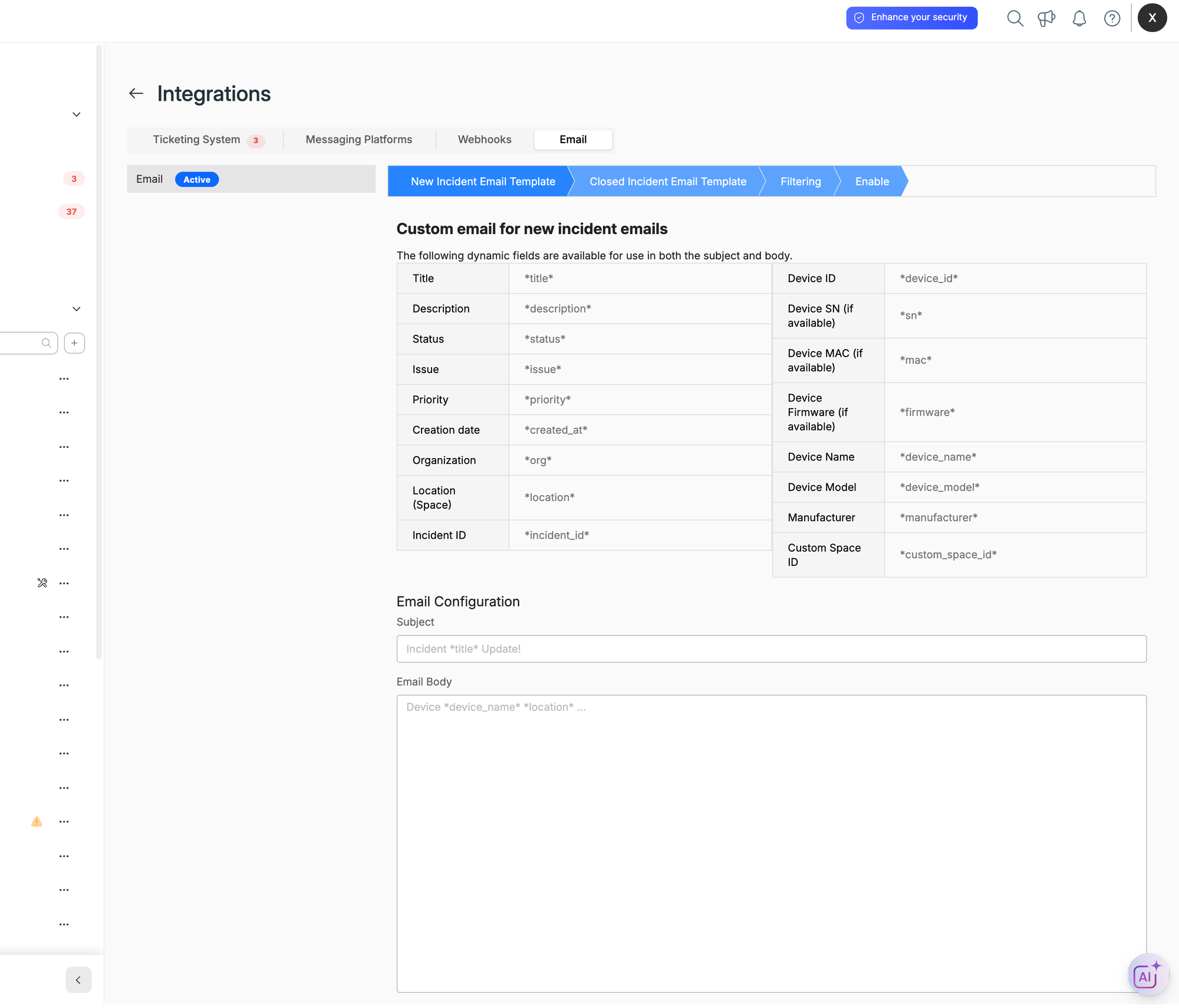
Available dynamic fields
| Field | Insert as |
|---|---|
| Title | *title* |
| Description | *description* |
| Status | *status* |
| Issue | *issue* |
| Priority | *priority* |
| Creation date | *created_at* |
| Organization | *org* |
| Location (space) | *location* |
| Incident ID | *incident_id* |
| Device ID | *device_id* |
| Device serial number (if available) | *sn* |
| Device MAC (if available) | *mac* |
| Device firmware (if available) | *firmware* |
| Device name | *device_name* |
| Device model | *device_model* |
| Manufacturer | *manufacturer* |
| Custom space ID | *custom_space_id* |
The same fields are available in both the subject and the body.
Report only the incidents that matter
The Filtering step limits which incidents send an email at all. Pick a value under Minimum incident priority to report and click Save filtering:
| Option | Emailed |
|---|---|
| No filter — send everything | Every incident (default) |
| Critical and above | Critical only |
| High and above | Critical, High |
| Moderate and above | Critical, High, Moderate |
| Low and above | Critical, High, Moderate, Low |
| Planning and above | Every incident |
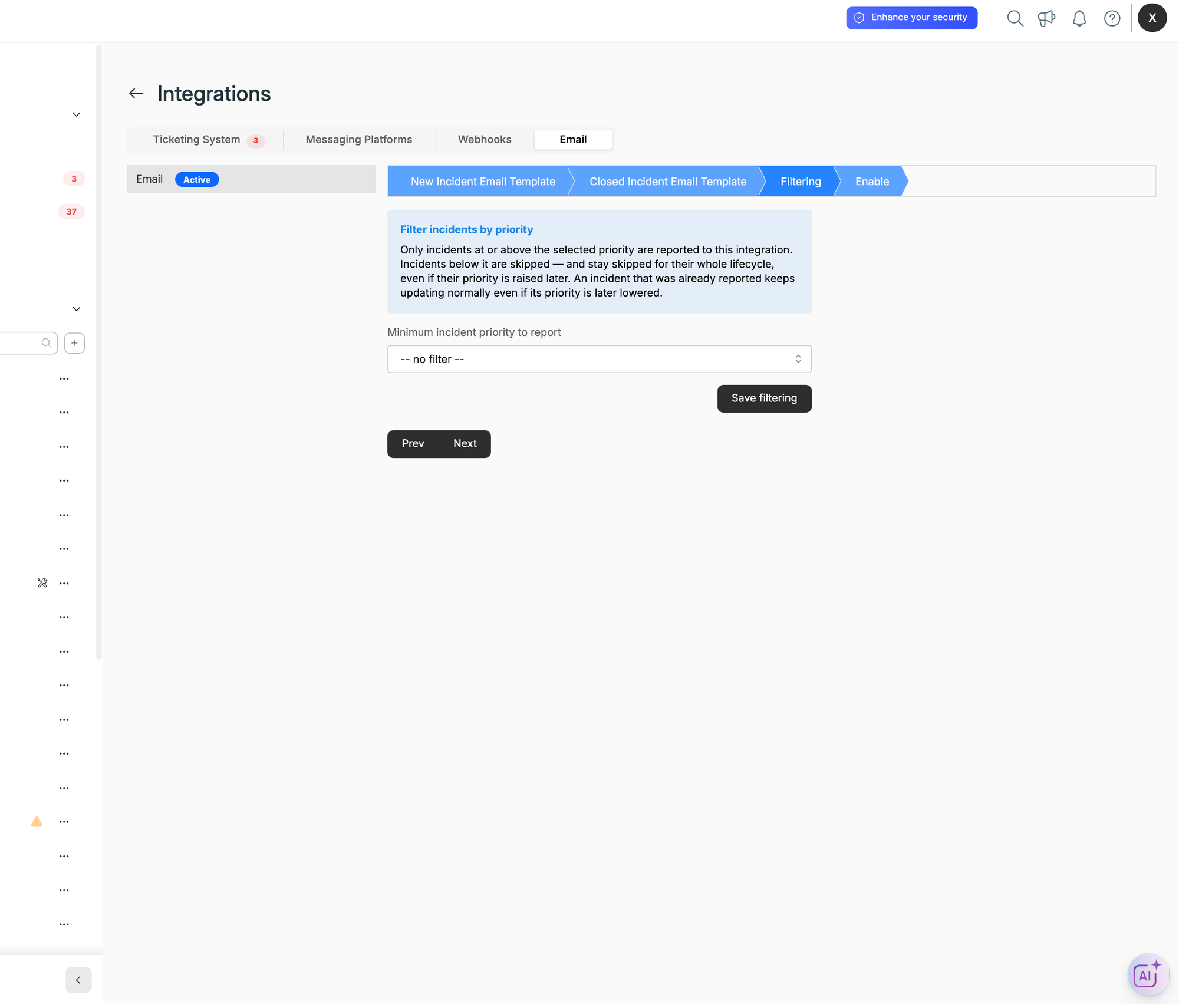
- An incident below the threshold is skipped, and stays skipped for its whole lifecycle — even if someone raises its priority later, and even for its closing email.
- An incident that was already emailed keeps updating normally, even if its priority is later lowered.
- The filter is per integration, so email can be noisier or quieter than your chat recipients.
- You can also set this for all your integrations at once from the Integrations list.
This integration is stable — we haven't had issues that call for a dedicated troubleshooting guide. If you run into a problem, contact [email protected] and we'll help.
Updated 11 days ago